Google’s E-E-A-T framework is a set of parameters that help decide which websites to trust and display to users. The framework includes Experience, Expertise, Authoritativeness, and Trustworthiness (E-E-A-T). Understanding these 4 parameters allows you to craft content to meet Google’s quality bar.
The E-E-A-T framework is not a direct Google ranking factor; however, it helps you design quality content. Optimizing it is strongly correlated with your SEO success in the digital space. Additionally, it gives websites a better chance to be visible in AI search results. In this guide, I’ll cover E-E-A-T and why Google cares about it when ranking websites.
What are E-E-A-T Guidelines?
E-E-A-T is a framework that Google uses to assess the quality of content appearing in search results. It follows Google’s Search Quality Rater Guidelines, where human reviewers judge the quality of the content in search results. This feedback acts as training data to help improve Google’s search algorithm.
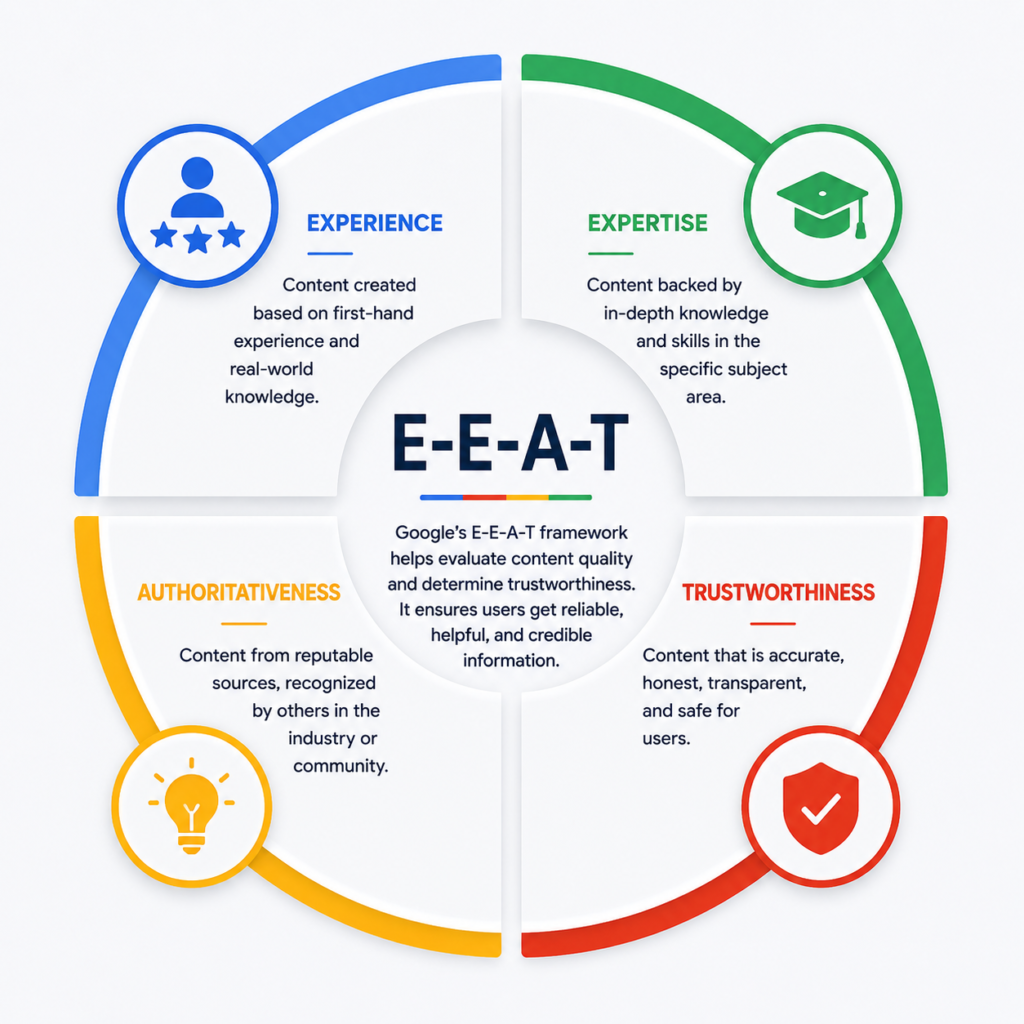
Google prefers to deliver trustworthy content to protect its users from harm and provide the best experience. If the human reviewers find the content to be lower quality, it will provide input to improve the ranking algorithm. Content about finance, health, legal advice, and safety has a high ceiling in E-E-A-T. This is because it can have serious repercussions if a website gives bad advice. So, there is more scrutiny on these pages compared to other standard pages.
Google initially launched E-A-T in 2014, but introduced Experience in 2022 as it prioritizes content with firsthand knowledge. This allowed quality raters to understand the quality of firsthand experience. For example, if you are writing a product review, you’d be more trustworthy if you have used the product yourself.
Why is E-E-A-T Important for SEO?
E-E-A-T guidelines lay the foundation for creating quality content that performs well on Google results. Google looks for content that covers the 4 parameters of E-E-A-T to rank pages. While it is not a direct ranking factor, the quality raters determine how search results will be shaped.
When you focus on E-E-A-T, your site aligns with Google’s good search results. Optimizing Google’s ranking factors is important, so you need to consider it as an indicator of these factors. Following these best practices, you can boost your content quality and indirectly boost your website SEO.
E-E-A-T was developed for search engines; however, it is also relevant for AI. It works to build topical authority and earn quality backlinks. This helps it with SEO and answer engine optimization (AEO).
Components of E-E-A-T
Google’s Search Quality Rater Guidelines play a critical role in defining E-E-A-T and categorizing the content in different levels. Let’s look at the 4 components in detail below.
1. Experience
Experience is the real-world experience that you showcase through your content. Google’s quality raters will then determine whether it fits their set guidelines. Original content created by individuals is valued highly by search engines and users. This aspect mainly covers the on-page SEO of your website.
Experience can be demonstrated by:
- Sharing original research, stories, or sharing your success or mistakes.
- Adding original photos or videos
- Insights from experts that have firsthand experience
- Personal product trials
2. Expertise
Expertise is the knowledge, skills, and credentials you hold in the field. The expertise depends on the purpose and topic of the page. It is very important in topics that involve YMYL (Your Money or Your Life) topics, such as money, safety, and medical-related fields.
In these areas, Google looks for:
- Licenses and professional affiliations
- Certified subject-matter expertise
- External certifications or references
When you are an expert in a space, numerous websites will automatically link to your website for its uniqueness and value.
However, for non-YMYL content, expertise can be demonstrated through
- Publishing high-quality content continuously
- Problem-solving capabilities relevant to a specific niche
- In-depth knowledge sharing that is useful to readers
3. Authoritaviness
Authoritativeness determines your reputation as a reliable source in the industry. It mainly focuses on off-page SEO of your page and achieving quality backlinks and mentions from reputable websites.
A few ideas to achieve authoritativeness include:
- Get high-quality backlinks from reputable websites
- Get mentions from industry leaders
- Post guest posts on higher authority websites in your niche
- Build topical authority to boost your website credibility
- Appear on podcasts, webinars, and interviews
- Perform digital PR to highlight your company’s achievements
4. Trustworthiness
Trustworthiness is a mix of experience, expertise, and authoritativeness. However, it also involves protecting your readers against misinformation or potential harm on your website.
You can build trust by:
- Providing clear, concise contact information with transparent privacy policies.
- HTTPS website encryption with a secure payment processing module.
- Ensuring the technical SEO of your website is up to the mark
- Accurate and verified content
- Proper disclosure of sponsored content.
- Displaying genuine customer reviews.
Trustworthiness is a key component of E-E-A-T, so ensure your page is trustworthy.
How to Improve Your Website’s E-E-A-T
Improving your website’s E-E-A-T is not as complicated as it seems. Let’s look into a comprehensive list of tips to improve them below.
1. Create Informational Content
Content is king in the digital ecosystem. Craft content that is helpful and relevant to your audience. Ensure that your content is accurate and up to date, using reliable sources to support your claims. In the content, you can add your personal experiences or testimonials to add better authenticity to the content. Try to create original content that naturally attracts links. Understand the pain points of your audience and address them through your content.
2. Reference Authoritative Sources
Add links to recognised industry publications or organisations, such as research papers, medical boards, and government agencies. This helps strengthen your content and makes it reliable. Additionally, when you link sources, readers know that you’ve done research and are not simply throwing claims.
3. Credit Authors
Provide credit to the authors who write your content to help build trust with your readers. Ensure that they have a bio page with detailed information, allowing readers to understand their expertise.
4. Build Your Brand Reputation
Your brand reputation impacts the trustworthiness of your content and your overall website. The best ways to have a strong brand presence online are through
- Digital PR, where journalists cover your brand on the channels.
- Guest posting on other sites in your niche.
- Hiring influencers to promote your brand
- Social media marketing
- Link building
Start Building Your Website E-E-A-T Today
E-E-A-T is an important Google parameter that helps build credibility and trust in search rankings. Boosting your E-E-A-T is an ongoing process that requires long-term commitment and effort. There are no shortcuts or quick fixes for it, so persistence is key.
What works throughout the process is consistency and regular expert content. Maintaining transparency with your audience and proving your expertise can boost your presence. These activities will yield results with time and create a strong foundation of your digital authority.
Want to optimize your content for SEO? Look no further. I’ve over 6 years of experience in the content space and am well-versed in the latest SEO strategies to rank your pages.
2 Responses
[…] Google’s E-E-A-T framework signals Experience, Expertise, Authoritativeness, and Trustworthiness for establishing high-quality content. It is not a direct ranking factor, but it offers guidelines on how Google evaluates systems to achieve lasting SEO success. […]
[…] user search intent or demonstrate experience, expertise, authoritativeness, and trustworthiness (E-E-A-T). Additionally, websites that load quickly and are easy to navigate are ranked higher. This is […]